
In Scout you monitor all your machines, including those without a CNC or PLC controller.
If your company has conventional machines – machines that are not numerically controlled by a CNC or PLC controller – and you want to monitor their work, we have a way to do it. This also applies to older CNC machines, press brakes and lasers without a usable control interface. Legacy machine monitoring in Scout is based on our BIOS-IO-01 module, which sends signals from the machine over the LAN.
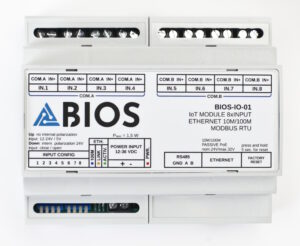
BIOS-IO-01
8 ISOLATED DIGITAL INPUTS
- 8 isolated digital inputs
- voltage inputs 0–24 V or dry-contact (NO) inputs with 24 VDC bias
- pulse counting up to 3 kHz on each input, also on all inputs at once
- Ethernet 10/100 Mbit
- power supply 12–36 VDC or Passive PoE via RJ45
- power consumption max. 1.5 W at 24 VDC; built-in reverse supply polarity, thermal and overload protection
- mounting on a 35 mm DIN rail
- configuration in a web browser, with no programming
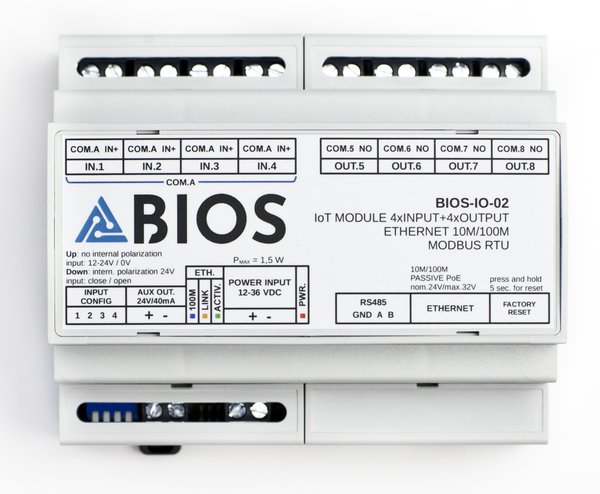
BIOS-IO-02
4 ISOLATED DIGITAL INPUTS + 4 RELAY OUTPUTS
- 4 isolated digital inputs: voltage 0–24 V or dry contact with 24 VDC bias, selected with a DIP switch; pulses up to 3 kHz
- 4 isolated NO relay outputs, static on/off or periodic operation – e.g. for signal lights or simple signalling devices
- Ethernet 10/100 Mbit, data in JSON over HTTP
- power supply 12–36 VDC or Passive PoE via RJ45
- mounting on a 35 mm DIN rail
- configuration in a web browser, with no programming
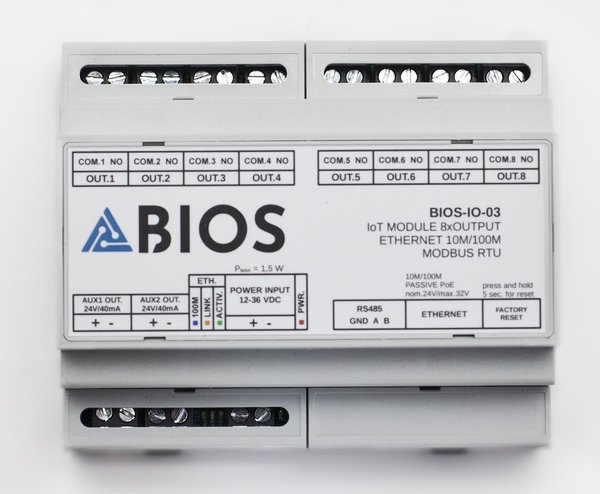
BIOS-IO-03
8 RELAY OUTPUTS
- 8 isolated NO relay outputs, static on/off or periodic operation – e.g. for flashing signal lights
- 2 built-in 24 V outputs (AUX1, AUX2) to power simple signalling devices
- Ethernet 10/100 Mbit, data in JSON over HTTP
- power supply 12–36 VDC or Passive PoE via RJ45
- mounting on a 35 mm DIN rail
- configuration in a web browser, with no programming
How it works
The signal from the machine goes to the inputs of the BIOS-IO-01 module, and from there over the LAN to our SCT software. SCT passes the data on to the Scout server.
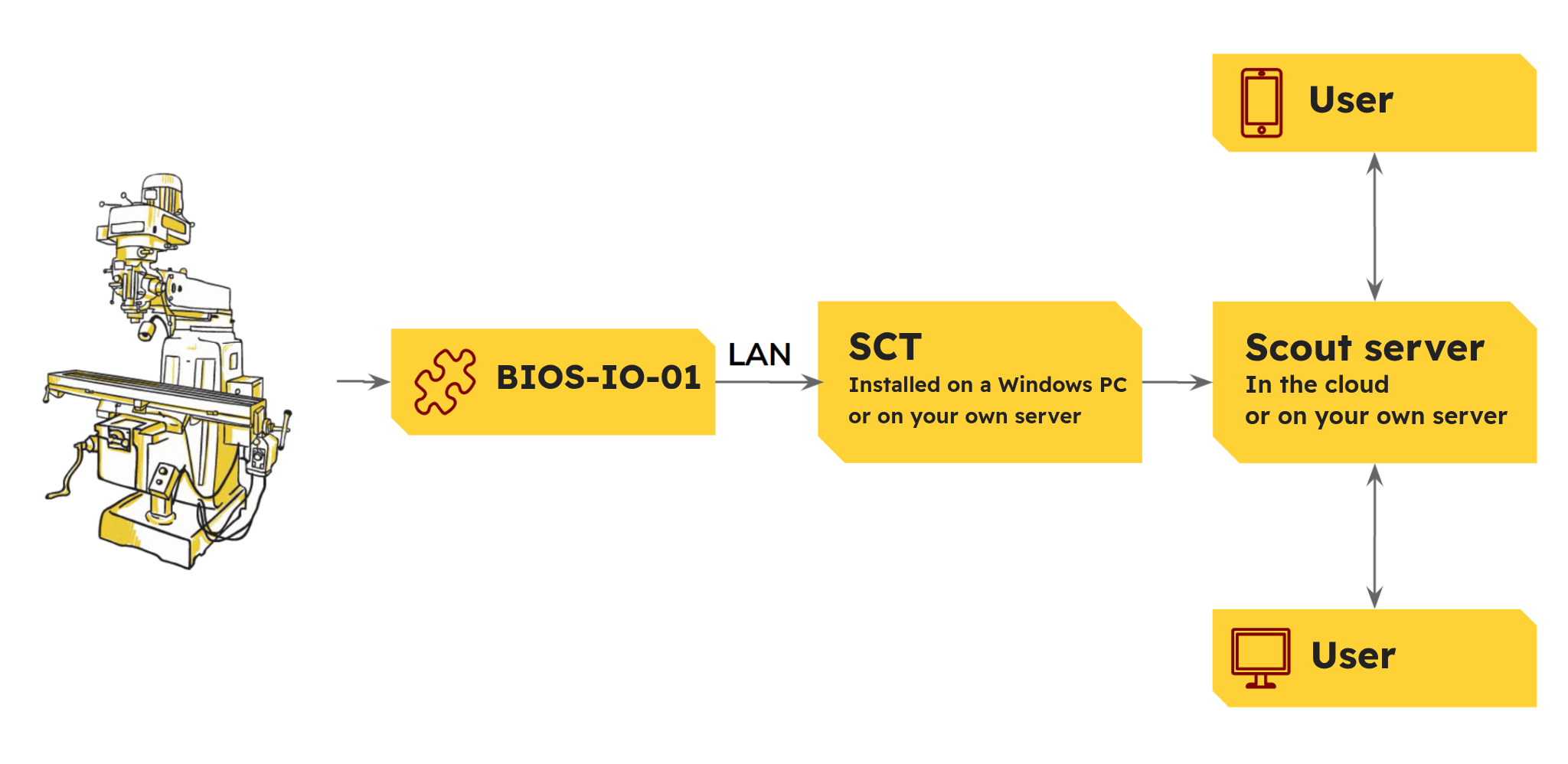
We often connect the signal from the signal tower mounted on the machine to the module’s inputs. The inputs can also work in pulse-counting mode. Setting up the module comes down to setting its IP address in the LAN.
Examples of information we read through BIOS-IO-01:
- machine state: running, not running, alarm, etc.
- the state of peripherals, e.g. an open machine door
- the moment the pedal is pressed on a press brake (= work)
- a part counter, if a suitable signal is connected to the input, e.g. in a paint shop or on a line where parts move along a conveyor
- other information that can be passed on as a 0–24 V DC voltage signal or a contact closure
With BIOS-IO-01, monitoring conventional machines covers every machine from which a run signal can be taken. More information is on bios-iot.com.